
By Ben Wright (@iamzavagno | www.xgeeks.co.uk)
This review is spoiler-free.
Synopsis:
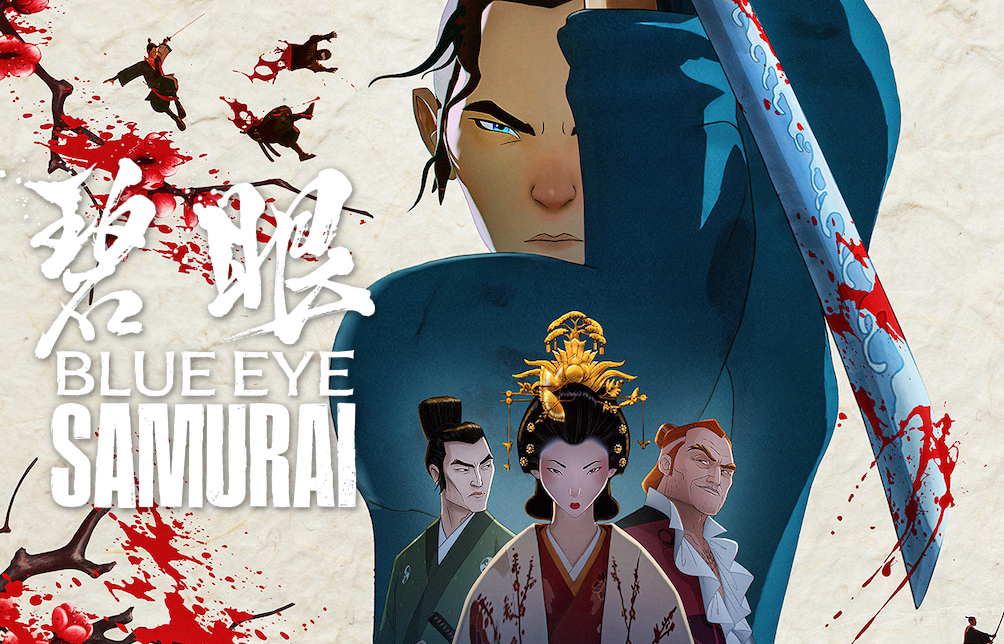
Driven by a dream of revenge against those who made her an outcast, a young warrior cuts a bloody path toward her destiny.
While I was eager to start Blue Eye Samurai, I don’t think anything could have prepared me for what I was about to experience…
Michael Green and Amber Noizumi have created a series that beautifully intertwines historical accuracy with a touch of mysticism, creating an intriguing blend of reality and folklore. Blue Eye Samurai is a well-crafted and thought-provoking series that combines action, culture, and personal growth – whilst delivering some of the most stunning visuals and action that you’ll ever experience.
While at its core, this is a story of revenge, don’t be fooled, as it covers a wide range of complex issues. Racial identity and gender, love, loss and anger – Blue Eye Samurai uses a multilayered approach to its storytelling. As well as the revenge elements and exploring one’s identity, Blue Eye Samurai exposes the patriarchal oppression of the time. This aspect not only adds a layer of realism and an obstacle to overcome in the plot, but you also feel the creator’s real-life experiences of modern-day society, not only that of being a woman but also of Asian or Asian American heritage. While the series has a plethora of complex themes, the feminist elements connect them all, and this only enhances the impact and enjoyment of Blue Eye Samurai. As a source of entertainment and as a society, we need more voices, like this, to be heard and new stories to be told. The series does not shy away from mature themes, yet nothing is gratuitous, as each element serves a purpose and layer of realism that strengthens the overall story and characters. The show uses visually creative and unique ways to tell its stories, and this is yet another reason that it separates itself from its peers.
The cast list is incredibly impressive, and while Maya Erskine (Mizu) is a stunning lead for the show, it is made even greater by the wealth of the ensemble cast – Masi Oka as (Ringo), Brenda Song (Princess Akemi), Randall Park (Heiji Shindo), Darren Barnet (Taigen), Kenneth Branagh (Abijah Fowler), Cary-Hiroyuki Tagawa (Swordfather), Ming-Na Wen (Madame Kaji) and George Takei (Seki). The characters are well-developed, each with their own depth and complexity, adding layers to the overarching narrative. There is not a single performance in the series that lets it down, everyone brings their A-game and this adds to all the other quality elements that make the series so spectacular.
As far as the production elements go, the choreography of the fight scenes is nothing short of spectacular, capturing the essence of a swordsperson and combat with impressive accuracy. Jane Wu’s unrivalled mastery is on full display and elevates the action and visual storytelling to immense heights. The cinematography and scenic backdrops transport viewers into the Edo period, and the costume designs are a visual delight, enhancing the authenticity of the setting. Amie Doherty’s musical score complements the action sequences and emotional moments flawlessly, intensifying the overall viewing experience.
In terms of negatives? There are none. At least nothing that at any time impacted my enjoyment of the series. It was incredible from start to finish. A perfect series. The last time I experienced an aminated series as consistent as this was Cyberpunk: Edgerunners – so Blue Eye Samurai sits in esteemed company!
With its breathtaking visuals, thought-provoking narrative and phenomenally choreographed action, Blue Eye Samurai shines bright as a genre-defining masterpiece that will stun audiences across the world.
 X-Geeks