
By Ben Wright (@Iamzavagno | www.xgeeks.co.uk)
This review is spoiler-free.
Returning to Pandora always feels like slipping back into a vivid dream, one you half remember but are still quietly amazed by when you open your eyes again. Avatar: Fire and Ash marks the next chapter in James Cameron’s long-planned saga, and even before getting into specifics, I was genuinely excited just to be back in this world. There is a real comfort to Pandora now, but also a sense of anticipation, the feeling that there are still corners of this planet we have not yet explored. This film leans into that sense of discovery while continuing the long-running conflict between the Na’vi and human forces, moving the story forward without demanding encyclopaedic knowledge of what came before.
Avatar: Fire and Ash once again follows Jake Sully and his family as Pandora becomes an increasingly contested space, both physically and emotionally. The film widens its scope, to a point, introducing new factions and environments that build naturally on what has already been established. It very much feels like a part 2 to The Way of Water, a connective chapter, setting pieces in place for what is still to come, but it never forgets to deliver spectacle in the moment.
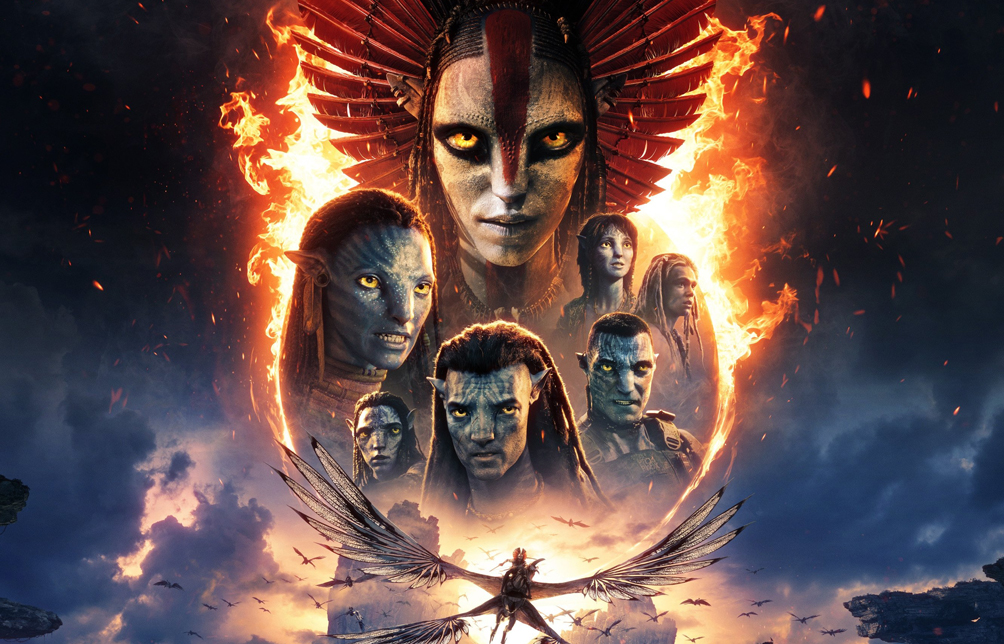
Visually, the film is consistently stunning. The technology behind it is clearly doing a lot of heavy lifting, but it never feels like it is showing off for the sake of it. Instead, it allows the imagination to run free, filling the screen with moments of genuine wonder, from sweeping landscapes to quieter, more intimate character beats. Pandora now feels fully realised, with a strong, established aesthetic that still leaves room to surprise, and that sense of awe remains one of the franchise’s greatest strengths.
Sam Worthington as Jake and Sigourney Weaver as Kiri once again stand out. Both bring a grounded sincerity that helps anchor the film, particularly when the scale threatens to overwhelm the characters. Zoe Saldana delivers another emotionally committed performance as Neytiri, though the writing continues to push her towards more abrasive territory. While there is some course correction in the final act, it often feels as though her character is written into corners that limit her complexity. Stephen Lang returns as Quaritch and is solid, although the sense of menace that once defined the character feels slightly diminished, with some familiar beats being revisited rather than expanded.
The most intriguing new presence comes from Oona Chaplin as Varang. Her introduction is striking and immediately memorable, hinting at a genuinely fresh direction for the story. Unfortunately, as the film progresses, she begins to drift into the background, reduced to more of a supporting role than her initial impact suggests. This is disappointing, as it feels like a missed opportunity to push the narrative in a bolder, less familiar direction.
That sense of familiarity extends to the writing as a whole. The film often treads recognisable ground, with story beats and resolutions that will feel very familiar to anyone who has seen the previous entries. The Avatar films have never been about complex plotting, and that is something I have long accepted, but as the third film in a five-part arc, I had hoped for more noticeable progression in the overarching story. There is a stretch in the middle of the second act where the film briefly loses momentum and starts to circle itself. Thankfully, it finds its way out and builds towards an epic final battle that easily stands as the most impressive action sequence the franchise has delivered so far. The scale, clarity and emotional weight of this sequence are genuinely breathtaking.
Despite its lengthy runtime, the film never feels like a slog. The pacing is mostly strong, aside from that mid-film lull, and there is more than enough action and visual storytelling to keep you engaged throughout. For full disclosure, I watched this movie at Odeon on a recliner, so I was very comfortable. I can’t say you won’t notice the runtime if you are sitting upright in an uncomfortable chair!
Look, these films are unlikely to ever win awards for narrative innovation, and that is fine. Their beating heart lies in their visuals, their score, and the sheer imagination on display, and Fire and Ash delivers all of that in abundance.
Visually breathtaking, with the most epic battle the franchise has offered so far, Avatar: Fire and Ash is an enjoyable addition to the saga and, despite the usual narrative shortcomings, will keep you entertained throughout.
 X-Geeks