
By Ben Wright (@Iamzavagno | www.xgeeks.co.uk)
This review is spoiler-free.
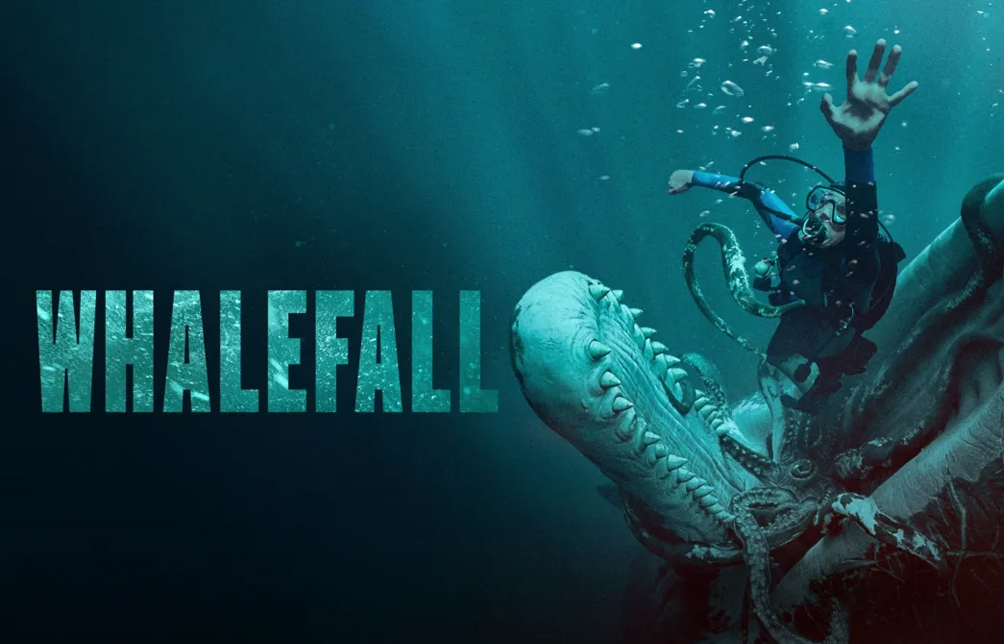
Austin Abrams is having another bad day! After finding himself in some pretty unfortunate situations in recent films, things take a particularly horrifying turn in Whalefall. Based on the novel by Daniel Kraus, the film follows Jay Gardiner, a young scuba diver who sets out to recover his late father’s remains, only to be swallowed by a sperm whale. With his oxygen running out and seemingly no way to escape, Jay faces a fight for survival unlike anything he could have imagined.
The trailer gives you a pretty good idea of what you’re getting with Whalefall, and I was expecting a claustrophobic, terrifying survival horror film. And don’t get me wrong, that’s exactly what you get, but what the trailer doesn’t quite prepare you for is the emotional weight of the story underneath all that stomach-churning horror. This is about so much more than a man trapped inside a whale, and I found myself getting far more invested in Jay’s story than I expected. Beneath the terrifying ordeal is a heartbreaking exploration of grief, loss and the complicated relationship between a father and son who struggle to tell each other the things they really need to hear. Sometimes the people we love most are the ones we find it hardest to communicate with, and Whalefall explores that in a way that really hit home for me.
The flashbacks have been a sticking point for some reviewers, but I actually thought they were one of the film’s biggest strengths. Without them, we’d have a man fighting his way through the stomach of a whale for the best part of two hours, which would certainly be an experience in itself, but wouldn’t have anywhere near the same emotional impact. Instead, director Brian Duffield uses Jay’s memories to build a picture of this fractured relationship, with past conversations and experiences taking on a different meaning as Jay fights to stay alive. There’s a cleverness to the way the film connects the whale’s anatomy and the lessons Jay learned from his father, bringing the two strands of the story together in some really interesting ways. It isn’t just about surviving what’s happening to him physically, but also coming to terms with everything he’s carrying emotionally.
What really got me was the film’s exploration of grief and regret. Losing someone doesn’t necessarily mean you’ve made peace with them, and sometimes the hardest part is living with all the things you never got to say, or wishing you could take back the things you did. That complicated mix of resentment, love and unfinished business is at the heart of Jay’s relationship with his father, and it gives every step of his desperate fight for survival another layer of meaning. Watching someone battle to stay alive while carrying so much emotional baggage makes those moments of survival feel even more significant. Life is unpredictable, and we never know how much time we have left with someone. Sometimes you need to take that leap and say what’s on your mind while you still have the chance, because you might not get another one. I thought the film handled that idea in a genuinely poignant way, and it was the emotional side of the story that stayed with me just as much as the horror.
Of course, the survival side of Whalefall is absolutely fantastic, and a huge part of that comes down to the work that went into bringing the whale to life. Wētā Workshop, whose work on The Lord of the Rings films remains legendary, helped create an environment that’s as slimy, grotesque and terrifying as you’d hope. The different stomach chambers feel like living, breathing spaces, and the practical sets make a massive difference to the claustrophobia. Duffield and the crew went to some brilliant lengths to make the environment feel unpredictable, including having crew members physically move the sets to simulate the whale’s contractions. Rather than relying entirely on digital environments, the filmmakers created something tangible for the actors to work within, and you can really feel the difference. The use of LED lighting to create the whale’s eerie bioluminescent glow is another great touch, while using real water adds an unpredictability that makes the whole ordeal feel even more convincing. It’s a brilliant example of practical filmmaking and visual effects working together, and I wish more films would put this much thought into how they create their worlds.
Austin Abrams is incredible here, carrying so much of the film on his shoulders while making Jay’s desperate attempts to survive feel genuinely exhausting. There’s a physicality to his performance that sells the sheer terror of his situation, but it’s the quieter, more emotional moments that really got me. Josh Brolin is equally excellent as Mitt, and their performances together give the father-son relationship the weight it needs. So much of what passes between them is left unsaid, and I thought both actors did a fantastic job of conveying that frustration, resentment and underlying love without needing to spell everything out. You believe the history between these two characters, which makes the emotional payoff all the more effective.
Sound is just as important to the experience as the visuals. The underwater noises, the whale’s deep, guttural calls and those strange clicks create an atmosphere that’s genuinely unsettling, and hearing all of this reverberate around a cinema makes the whole thing feel even more intense. This is absolutely a film I’d encourage people to see on the big screen while they still have the chance. The score is excellent, too, but there’s one particular musical moment towards the end that really stood out to me. The choice of song, the visuals and the emotional weight of everything that’s come before combine to create a moment that genuinely left me gasping for air, almost as much as Jay himself. It’s the kind of sequence that works because you’ve become so invested in the character and everything he’s been through, and I thought it was a wonderful payoff.
Whalefall is a visually and sonically stunning film, with some fantastic practical effects, a genuinely terrifying survival story and performances that give the whole thing real emotional weight. I can understand why some viewers might have wanted more time spent on the immediate survival aspect, but for me, the flashbacks are what elevate this beyond a straightforward creature feature. I went in expecting a brutal fight for survival and came away with something far more moving than I anticipated. Austin Abrams and Josh Brolin are brilliant, and if you get the chance to experience this one in the cinema, I’d absolutely recommend taking it.
Whalefall delivers claustrophobic survival horror, outstanding practical effects and fantastic performances, but it’s the heartbreaking story of grief, regret and a complicated father-son relationship that makes this one so memorable. A terrifying and emotional creature feature that’s well worth seeing on the big screen.

